See what you can claim this year and how to reduce your tax bill
Dear [First Name],
Welcome to your March 2026 update from SK Financial CPA. This month we’re sharing the latest tax changes, new deductions you can actually use for 2025, and a few important shifts in the economy that could affect your income, expenses, and planning decisions.
New Deductions You Can Claim
The IRS has published updated Schedule 1-A and Form 1040 instructions for 2025. Four major new deductions are now available and they can be taken whether you file the standard deduction or itemize. This is a significant change that benefits millions of American taxpayers.
No Tax on Tips — Up to $25,000
Workers who receive tips can now deduct up to $25,000 in qualified tip income directly from their taxable income. This deduction phases out for individuals with a Modified Adjusted Gross Income (MAGI) above $150,000, or $300,000 for joint filers. If you work in hospitality, food service, beauty, or any tipped industry, this could meaningfully reduce your tax bill for 2025.
No Tax on Overtime — Up to $12,500 or $25,000
Qualified overtime pay is now deductible. Individuals can deduct up to $12,500; married couples filing jointly can deduct up to $25,000. This applies to W-2 overtime compensation reported on your paycheck. The deduction is available on top of your standard deduction no need to itemize.
Car Loan Interest Deduction — Up to $10,000
For the first time, taxpayers can deduct interest paid on a qualified passenger vehicle loan. The maximum deduction is $10,000 per return. This applies to personal vehicle loans not business vehicles (which already have separate deduction rules). If you have a car loan, keep your lender statements for documentation.
Enhanced Senior Deduction — $6,000 Per Person
Taxpayers born before January 2, 1961 meaning anyone who turned 65 or older in 2025 qualify for an additional $6,000 deduction ($12,000 for married couples both over 64). This is on top of the existing higher standard deduction already available to seniors. Phase-outs apply based on MAGI levels.
Planning Tip from SK Financial CPA
These four deductions are stackable. A senior tipped worker with a car loan could potentially reduce taxable income by $41,000 or more before accounting for any other deductions. Contact our team to model the specific impact for your household or business.
Tax Credits Every Parent Should Know for 2025
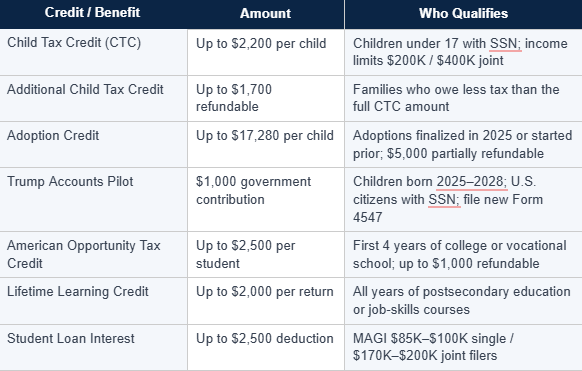
Several enhanced credits and a brand-new pilot program are available for the 2025 tax year. Here is a summary of what applies to you and your family.
New: Trump Accounts for Children Born 2025–2028
Parents or guardians of children born in 2025, 2026, 2027, or 2028 can elect to establish a Trump Account on their child's behalf. The federal government makes a one-time $1,000 contribution. The child must be a U.S. citizen with a Social Security Number. A new Form 4547 (Trump Account Election) is required. Talk to us before filing — this requires a specific election and deadline.
Where Tariffs Stand After the Supreme Court Ruling
The Supreme Court struck down several of the broad tariffs the Trump administration imposed under a 1970s trade law including the April 2025 reciprocal rates on all countries and duties tied to drug trafficking retaliation on Canada, Mexico, and China. However, the trade picture remains complicated and in flux.
The administration was prepared for this outcome and has continued imposing tariffs through alternative legal authority. Businesses that import goods face ongoing uncertainty as new targeted tariffs are being developed for additional product categories.
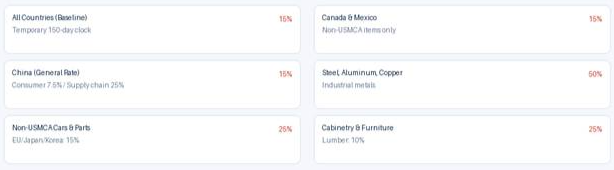
What Remains in Place Today
A new temporary 15% baseline rate on all countries, imposed under a different legal authority. These last 150 days unless Congress extends them.
Tariffs on steel, aluminum, and copper at 50%.
Cars and car parts: 25% for non-USMCA vehicles (15% for EU, Japan, and South Korea).
Wood products: cabinetry and furniture at 25%; lumber at 10%.
Targeted duties on specific China categories remain.
New Tariffs Coming
Federal agencies are currently investigating the following sectors for future targeted tariffs. Expect more products to join this list in coming months:
Semiconductors and related components
Pharmaceuticals
Critical minerals used in military and industrial applications
Civilian aircraft and drones
Robotics
Business Impact: What to Plan For Now
Importers may be owed refunds on struck-down tariffs, but the fate of roughly $130 billion in collected revenue is still being decided by lower courts and the government may push back on issuing refunds. Some trade deals with South Korea, Japan, and Taiwan that were built around now-removed tariffs may also unravel. Plan inventory, pricing, and supply chain decisions conservatively until long-term rates stabilize.
Inflation Should Ease in 2026
The overall trend since the 2022 peak near 9% remains positive. The base case for 2026 is continued, gradual easing. That said, several forces could push prices back up especially in the second half of the year and they are worth watching closely if your business or investment plans depend on lower inflation.
What Could Keep Inflation Elevated
AI Infrastructure Spending: Tech companies have budgeted roughly $650 billion in data center and equipment spending this year alone. This is pushing up costs across construction, electronics, and power generation. Electricity rates in particular are likely to keep rising and those feed into nearly everything else.
Tariff Pass-Through: Importers who absorbed tariff costs rather than raising prices are beginning to pass them on to consumers. This delayed effect could add to inflation in the months ahead.
Labor Market Tightening: The pool of available workers has shrunk. Industries that historically relied on immigrant labor including manufacturing, agriculture, construction, food service, and child care face particularly tight labor markets. If hiring picks up, wages could push prices higher.
Strong Consumer Spending: Affluent households supported by strong stock market gains continue to spend. Additional tax rebates going out in the coming months could further fuel demand.
SK Financial Note
If your business or investment plans rely on meaningfully lower interest rates or tamed inflation by late 2026, build in contingency. These risks do not mean inflation will spike but they make the second half of 2026 worth watching carefully.
Key Numbers This Month
GDP & Growth Outlook
The U.S. economy is projected to expand by 2.8% in 2026 a meaningful step up from 2.2% in 2025, despite a below-average 1.4% GDP reading in last year's fourth quarter. Growth is expected to be supported by above-average tax refunds, a high-value stock market, continued AI-related business investment, and a possible recovery in manufacturing.
Starting in 2027, economic growth is expected to settle back toward its long-term average of approximately 2.0% constrained primarily by slow labor force growth, even if productivity gains from AI remain elevated.
Gas Prices
After hitting a five-year low, gas prices are moving back up. The national average for regular unleaded bottomed around $2.80 in January and has since climbed to approximately $2.95. Expect a further rise to just over $3.00 this spring, driven by seasonal demand patterns and refinery transitions to summer-blend fuel. Diesel is currently averaging $3.73 a few cents more than a year ago. Middle East tensions and potential disruptions to the Strait of Hormuz remain a tail risk for a sharper spike.
Small Business Sentiment
The National Federation of Independent Business Optimism Index fell slightly in January but remains above its historical average. The key concern: uncertainty is at its highest level since early 2025. Just 21% of small business owners expect general economic conditions to improve. Labor quality remains a top challenge especially in construction. On the positive side, capital spending saw a significant jump, with 60% of owners reporting capital outlays in the past six months the highest level since 2023.
Mortgage Lending Could Get Easier
The Federal Reserve is preparing rule changes that would reduce the capital banks must hold when originating and servicing mortgages. Currently, banks apply a 250% risk weight to mortgage servicing rights compared to just 50% for mortgages on their books a mismatch that the banking industry says has limited their participation in the mortgage market since the 2008 financial crisis.
What This Means for You
If you are planning to purchase a home, refinance, or invest in real estate in 2026 or 2027, watch for improved lending terms as bank competition increases. If your business relies on commercial real estate financing, these structural shifts in the mortgage market are worth tracking.
Solar Surges, AI Raises Power Costs, Data Centers Under Fire
Renewable Energy
Solar remains the fastest-growing source of U.S. utility-scale power generation. Approximately 70 gigawatts of new solar capacity is expected to come online in 2026 and 2027 a 49% increase compared to current levels. Much of this growth is concentrated in Texas, supported by rapidly expanding battery storage infrastructure projected to reach 37 gigawatts by the end of 2027.
Natural gas remains the largest source of electricity generation at 40% down from a peak of 42% in 2024. Coal continues its long-term decline, expected to fall to 15% of generation by 2027 despite ongoing efforts to keep older plants running.
Data Centers & Rising Electricity Costs
U.S. residential electricity rates have risen approximately 37% since 2020, and AI-related data center growth is a major contributing factor. Bipartisan legislation has been introduced in Congress that would require new data centers to supply their own power separate from the consumer grid and give existing facilities a decade to find alternative energy sources.
Around 30% of planned U.S. data center capacity is already moving toward behind-the-meter resources such as natural gas turbines and solar-plus-storage. Expect that share to grow as operators seek to avoid political pressure around consumer utility costs.
Robotics & U.S. Competitiveness
China installed nearly 300,000 industrial robots in 2024 more than half of all global deployments. The U.S. installed just 34,000. A bipartisan push in Congress is now underway to create a national robotics commission and develop a U.S. strategy for manufacturing, AI-driven automation, and competing with heavily subsidized Chinese robotics.
Cybersecurity Alert: "Recommendation Poisoning"
A growing AI threat: hidden instructions embedded in documents, emails, or web pages can manipulate AI assistants into secretly recommending products or services. This happens when you click "summarize with AI" on a compromised site or paste text from a scammer. Advice: hover over links before clicking, be skeptical of AI summarize buttons, and regularly clear your AI assistant's memory in settings.
Stay connected with us! Follow SK Financial CPA on social media for the latest updates, tips, and tax news. If you have any questions or need assistance with your 2025 tax return, don’t hesitate to get in touch. We’re here to help.
SK Financial CPA
2210 Ashley Oaks Cir #101, Wesley Chapel, FL 33544, US
Fancy seeing you down here. You’re getting this email because you subscribed to us